


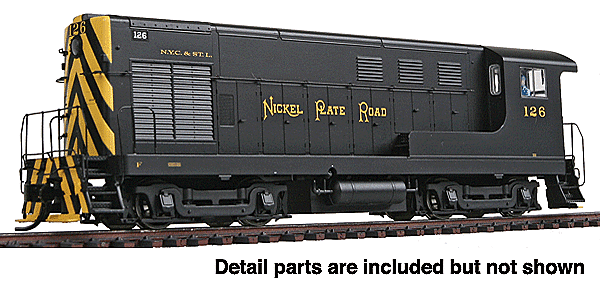
1940s-Era Switchers with 21st Century Detailing
* Prototype-Specific Detailing * Magnetic Knuckle Couplers * All-Wheel Drive & Electrical Pickup * Machined Brass Flywheel * Constant & Directional Headlights * RP-25 Wheels * Heavy Die Cast Chassis * Five-Pole Skew-Wound MotorBy the early 1930s, Fairbanks-Morse was ready to expand its line of diesel prime movers with a new design aimed at railroads. The new Model 38 as it was known used opposed pistons in place of a traditional cylinder head to form the combustion chamber. Although more mechanically complex, it was very smooth running and quiet when properly adjusted. The original six-cylinder 5 x 6" design could generate 300 horsepower; the Milwaukee Road had a single rail car, and the Baltimore & Ohio had two fitted with these engines. Larger eight-cylinder 8 x 10" models soon followed, producing 1,300 horsepower. This version caught the eye of the US Navy, who ordered several for submarines. In 1938, these same engines were selected by the Southern Railway to power five new lightweight rail cars.
But further railroad sales were put on hold as the nation entered World War II and the Navy needed every Model 38 it could get. As the war began winding down, F-M was given the OK to build a prototype loco to test civilian applications for the Model 38. On August 21, 1944, F-M rolled out its first H10-44; H for a hood-type car body, 10 for 1000 horsepower and 44 for a B-B (four axles and four traction motors) wheel arrangement. Raymond Lowey designed the body, which featured a gently sloped nose and a rounded roof extending back over the cab. The prototype went to work for the Milwaukee Road, who placed the first large order for 10 in 1945. Some 197 were built through May of 1950 when a 1200-horsepower version (H12-44) was introduced. These models used the same body through 1952. Some H10s and H12s soldiered on into the early 1980s, often working for shortline and industrial users. The first H10 was restored by the Illinois Railway Museum and is still in operation.