


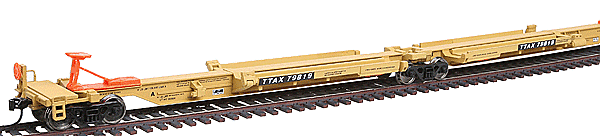
* Ready to Run
* New Roadnumbers
* Metal RP-25 Wheels
* PROTO-Max(TM) Metal Knuckle Couplers
* Razor Sharp Paint & Lettering
* Modeler-Installed Grab Irons Included
* Great For Freight & Intermodal Consists
* In Use from 1988 to Today
Introduced in 1988, the All-Purpose Spine Car is an outgrowth of several earlier designs.
Many of the principles were introduced on the Fuel-Foilers, developed by the Santa Fe in the mid 1970s for trailer service. These cars were built around a center-beam frame, (known today as a spine) fitted with a trailer hitch and platform for the wheels. The articulated design eliminated couplers between units, reducing slack action and load damage.
Trailer Train began a series of design experiments along similar lines, introducing its Four-Runner in 1981. Consisting of four drawbar-connected units, these cars could haul trailers from 40 to 45' in length. This lightweight design was not overly popular, but it paved the way for a stand-alone version, called the Front Runner, which could handle the newer 48' vans then coming into service.
By 1986, larger containers and double-stack cars were becoming standard equipment for intermodal service. But many railroads had low clearances or insufficient container traffic that made double-stack cars impractical. These lines needed a lightweight, articulated car and Trailer Train responded with the Spine Car. Each consisted of five units, set up to carry a single stack of containers ranging from 20 to 48' long.
Working with the railroads to determine their changing requirements, Trailer Train introduced the All-Purpose Spine Car in 1988. Equipped to carry containers and trailers at the same time, each of the five units in the car is fitted with collapsible hitches and container locks. Trailers from 28 to 48' long, or 40, 45 or 48' containers can be carried. The end (A&B) units have additional locks to carry a pair of 20' containers. Brake wheels are installed on each end unit, reducing the rigging to activate the hand brakes.
Today, these all-purpose cars can be seen running in general freights, or with other types of intermodal equipment.
* New Roadnumbers
* Metal RP-25 Wheels
* PROTO-Max(TM) Metal Knuckle Couplers
* Razor Sharp Paint & Lettering
* Modeler-Installed Grab Irons Included
* Great For Freight & Intermodal Consists
* In Use from 1988 to Today
Introduced in 1988, the All-Purpose Spine Car is an outgrowth of several earlier designs.
Many of the principles were introduced on the Fuel-Foilers, developed by the Santa Fe in the mid 1970s for trailer service. These cars were built around a center-beam frame, (known today as a spine) fitted with a trailer hitch and platform for the wheels. The articulated design eliminated couplers between units, reducing slack action and load damage.
Trailer Train began a series of design experiments along similar lines, introducing its Four-Runner in 1981. Consisting of four drawbar-connected units, these cars could haul trailers from 40 to 45' in length. This lightweight design was not overly popular, but it paved the way for a stand-alone version, called the Front Runner, which could handle the newer 48' vans then coming into service.
By 1986, larger containers and double-stack cars were becoming standard equipment for intermodal service. But many railroads had low clearances or insufficient container traffic that made double-stack cars impractical. These lines needed a lightweight, articulated car and Trailer Train responded with the Spine Car. Each consisted of five units, set up to carry a single stack of containers ranging from 20 to 48' long.
Working with the railroads to determine their changing requirements, Trailer Train introduced the All-Purpose Spine Car in 1988. Equipped to carry containers and trailers at the same time, each of the five units in the car is fitted with collapsible hitches and container locks. Trailers from 28 to 48' long, or 40, 45 or 48' containers can be carried. The end (A&B) units have additional locks to carry a pair of 20' containers. Brake wheels are installed on each end unit, reducing the rigging to activate the hand brakes.
Today, these all-purpose cars can be seen running in general freights, or with other types of intermodal equipment.