

Part # 932-2557
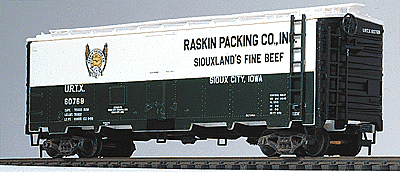
40' General American Meat Reefer - Kit -- Raskin Packing Co
$10.98
Out of Stock
Availability: Discontinued
HO
Scale
Private/Industrial Owner
Walthers Part# 932-2557


Product Information
Although outwardly similar to produce reefers, meat reefers were built especially for their cargo. Some cars were equipped with hooks riding on overhead rails, identical to those used in slaughterhouses and processing plants, to simplify loading and unloading. Meat reefers were cooled with ice or a mixture of ice and salt called brine.
Meat traffic was big business for many railroads in the 1950s and 60s. To get it over the line as fast as possible, reefers were blocked into solid trains which made them easier to service en route. Reefer blocks were given top priority, not only because of the perishable cargo, but to avoid re-icing, which was an added expense.
Adding a fleet of these colorful cars to your railroad will provide all types of operating and switching possibilities. Available for the first time in plastic, these were some of the most colorful cars ever, in service from the 1940s to the 70s. The belt rail on the side distinguishes it from other meat reefers, and there's a full-height door, plus separate ends and roof.
Smaller packing plants, like the Cornerstone Series(R) Champion Packing Co.(933-3048), are a perfect destination for these cars. Before being loaded, cars will need to be iced. You can model a typical icing facility with the Ice House & Icing Platform (933-3049). Matching platform parts are offered in the Add-On Icing Platform (933-3050).
Meat traffic was big business for many railroads in the 1950s and 60s. To get it over the line as fast as possible, reefers were blocked into solid trains which made them easier to service en route. Reefer blocks were given top priority, not only because of the perishable cargo, but to avoid re-icing, which was an added expense.
Adding a fleet of these colorful cars to your railroad will provide all types of operating and switching possibilities. Available for the first time in plastic, these were some of the most colorful cars ever, in service from the 1940s to the 70s. The belt rail on the side distinguishes it from other meat reefers, and there's a full-height door, plus separate ends and roof.
Smaller packing plants, like the Cornerstone Series(R) Champion Packing Co.(933-3048), are a perfect destination for these cars. Before being loaded, cars will need to be iced. You can model a typical icing facility with the Ice House & Icing Platform (933-3049). Matching platform parts are offered in the Add-On Icing Platform (933-3050).
Copyright © 2025 Wm. K. Walthers, Inc. All rights reserved.